OVERVIEW
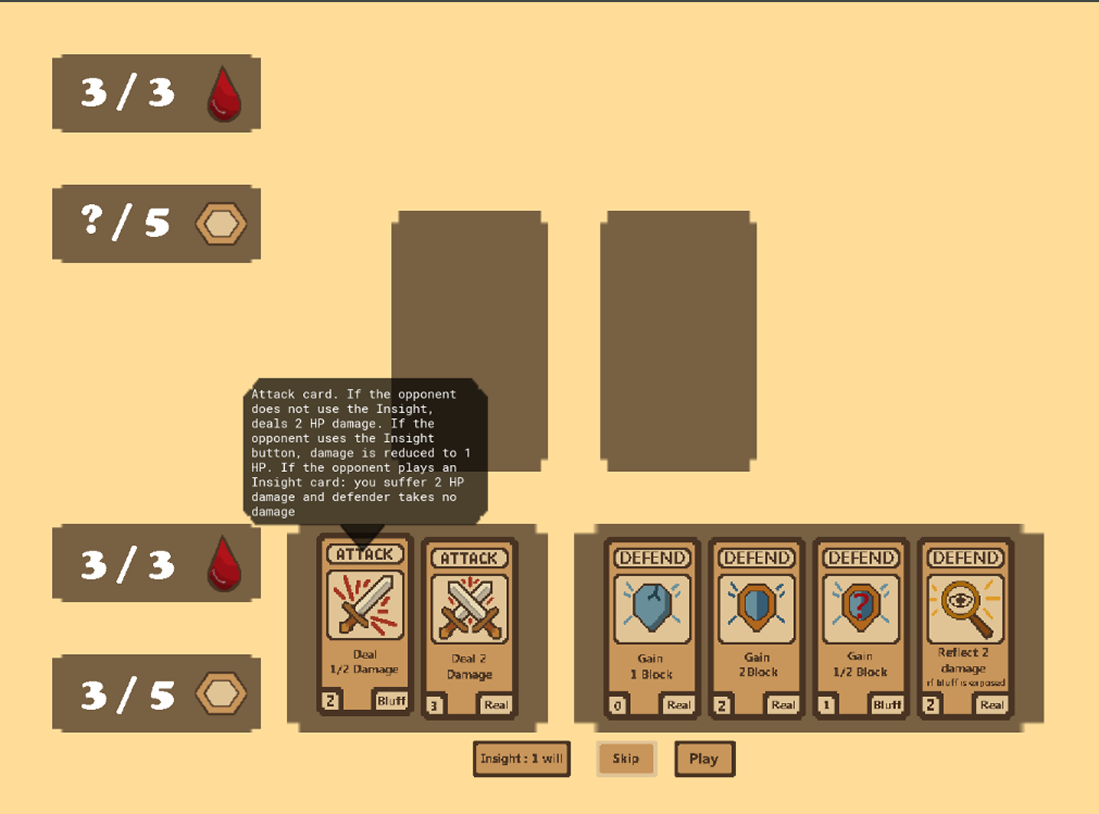
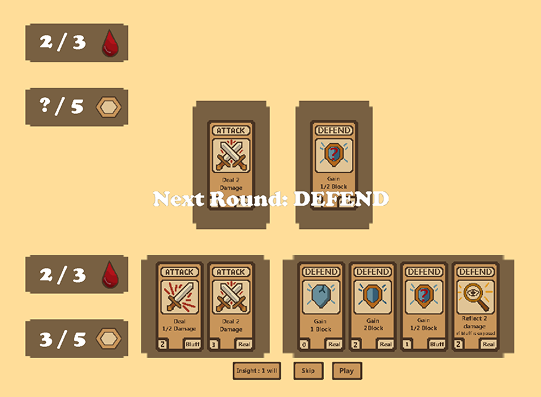
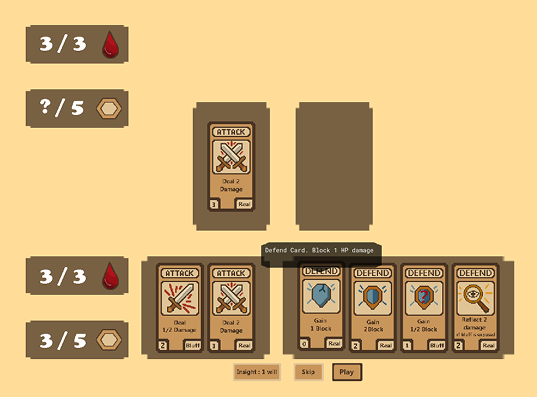
Bluff & Blade is a turn-based psychological card duel built on bluffing, resource management, and information control. The project began as a simple Rock-Paper-Scissors assignment and evolved into a system inspired by the idea of information entropy, exploring uncertainty. Each round, players and an AI opponent take turns attacking and defending while managing limited resources called Will. Success depends on how well players control information by hiding their own Will and estimating the opponent's to gain the upper hand.
DESIGN
Card and Resource System
Each player begins the game with a fixed hand of six cards and two action buttons (Insight and Skip). All actions—playing cards or using the Insight button—consume a shared resource called Will. Players start the game with 3 Will, and at the beginning of each turn, they gain +2 Will, up to a maximum of 5.
| Card Type | Effect | Cost (/will) |
|---|---|---|
| Attack | Deals 2 damage | 3 |
| Bluff Attack |
Unexposed: acts as a normal Attack (2 damage) Exposed by button: 1 damage Exposed by a card: attacker takes 2 reflected damage, defender takes none |
2 |
| Defend | Blocks 2 damage | 2 |
| Bluff Defend |
Unexposed: blocks 2 damage Exposed by button: blocks only 1 damage |
1 |
| Weak Defend | Blocks 1 damage | 0 |
| Insight (card) |
Can only be used when defending If the opponent plays Bluff Attack: reflects 2 damage and blocks all damage |
2 |
| Insight (Button) |
Challenges the opponent’s card authenticity and weakens exposed bluff cards Cannot be used with Insight card in same turn |
1 |
Bluff cards cost less Will, letting players appear threatening while conserving resources. Insight, on the other hand, provides information at a cost.
Visual Design
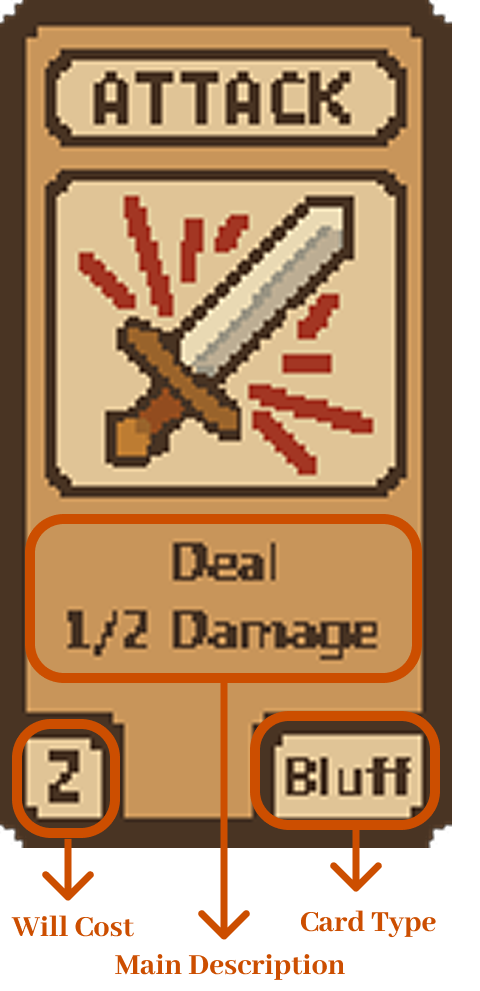
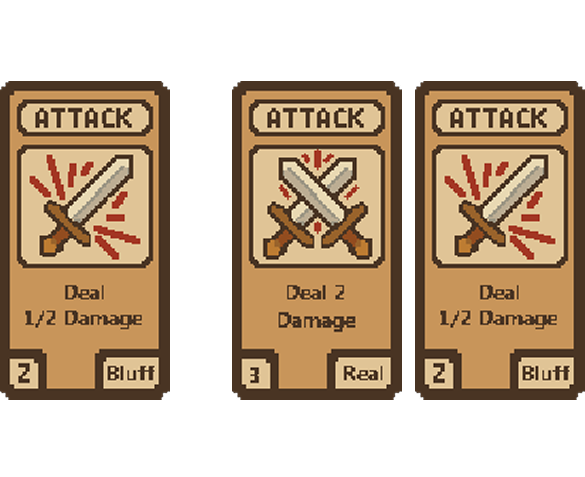
Component:
- Will Cost: The resource required to play the card.
- Main Description: Shows the card's primary effect. When hovering, a detailed illustration appear.
-
Card Type: Displays whether the card is real or bluff.
- If the player plays a real card, both players see the same card.
- If it's a bluff, the opponent sees the disguised version.
Game Flow
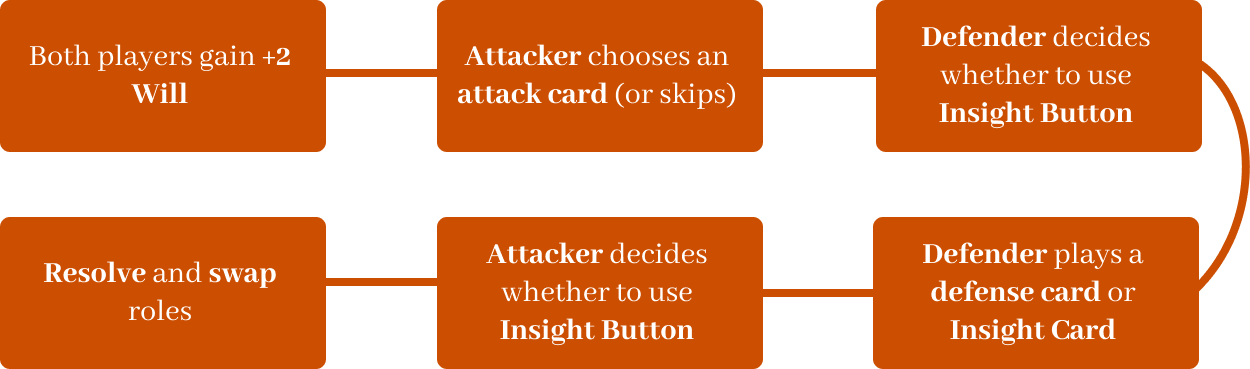
- Each round follows a turn loop where both the attacker and defender can choose to bluff their actions.
- The defender can use Insight after the attack is declared, and the attacker can use Insight after the defence is played.
- Players may skip their action to save Will.
- The game ends when a player's HP reaches 0, at which point the other player wins.
Information and Bluffing
Information control is key.
Throughout the match, players constantly estimate the opponent's Will. Accurate calculation can eliminate certain plays (e.g., knowing they can't afford a real attack). Insight makes that estimate more accurate, while bluffing keeps it uncertain.
Insight provides information.
It reveals the opponent's real card and the actual Will cost. This makes their resource state more predictable and narrows the range of possible actions in future turns.
Bluff creates uncertainty.
Bluff cards look like real cards from the opponent's perspective but cost less Will. This makes it harder to infer their remaining resources accurately and keeps their future options ambiguous.
TECHNICAL IMPLEMENTATION
AI Logic
This game includes a simple but functional AI opponent.
As Attacker
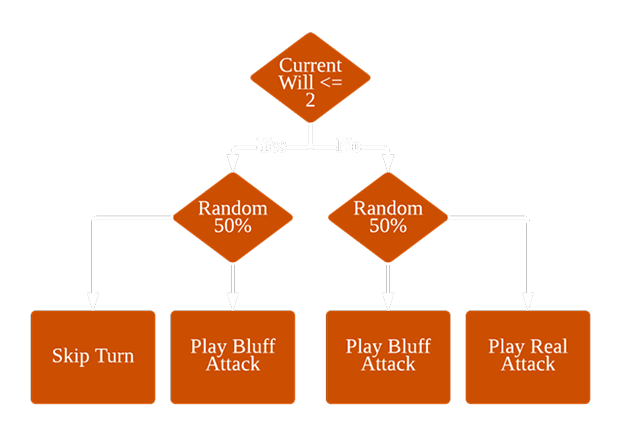
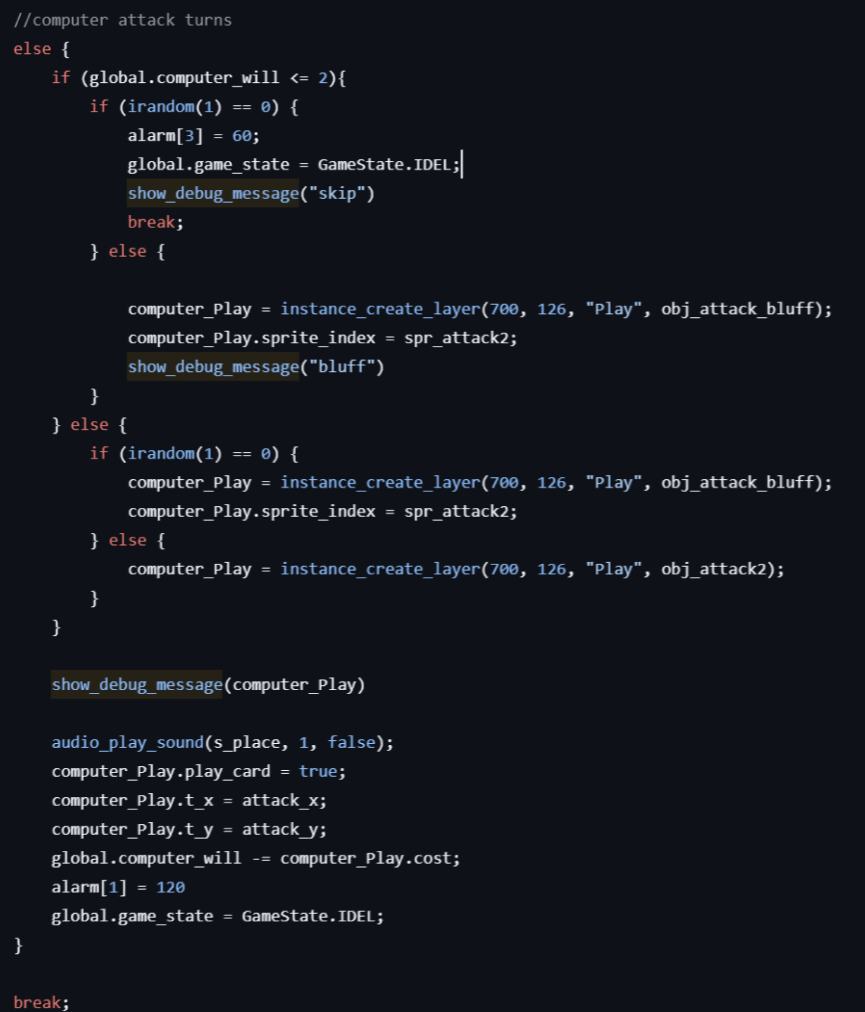
As the attacker, the AI evaluates its current Will and uses randomization to decide between skipping, bluffing, or playing a real attack.
As Defender
 1.png)
- The AI continuously maintains a list of possible player Will values throughout the match.
- At the start of each decision, it calculates the expected player Will based on this list.
- If the expected Will is high enough (e.g., ≥ 3), the AI assumes the player may perform a strong attack and is more likely to use Insight or play a real defend.
- If its current Will is low, the AI may bluff or save its own resources.
- Randomized choices (50%) are introduced in several branches to make the AI less predictable and to mimic human uncertainty.
GALLERY